

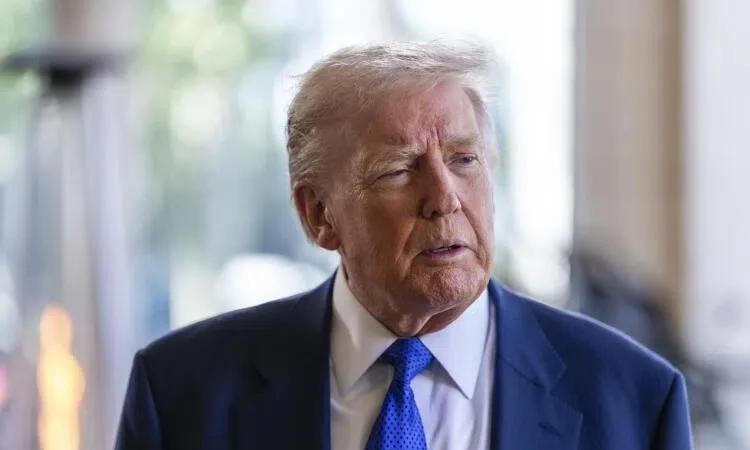
US President Donald Trump expressed optimism on Sunday regarding the possibility of reaching an agreement with Iran, even after the Iranian Supreme Leader Ayatollah Ali Khamenei warned that any US military action against the country would result in a regional war.
Trump’s comments come after a deadly crackdown on anti-government protests in Iran, which escalated last month. In response, Trump threatened military action and ordered the deployment of an aircraft carrier group to the Middle East.
Khamenei referred to the recent protests as a “coup,” condemning the demonstrations as violent acts, including attacks on police, government offices, military centers, and religious institutions. He warned the US that starting a war would ignite a regional conflict, while telling the Iranian people not to fear Trump’s rhetoric.
“They (protesters) attacked police, government centers, IRGC offices, banks, and mosques, even burning the Quran… it was like a coup,” Khamenei stated, adding that the “coup” had been suppressed.
In response to Khamenei’s warning, President Trump told reporters, “Of course, he is going to say that. Hopefully, we’ll make a deal. If not, we’ll see whether or not he was right.”
The unrest in Iran began with protests against rising living costs but soon evolved into a widespread anti-government movement. Iran’s leadership has labeled the protests as “riots” fueled by external forces, particularly the United States and Israel.
Meanwhile, Iran released 26-year-old protester Erfan Soltani on bail, following US threats to take action if any anti-government protester was executed. Soltani had been arrested in January for charges related to anti-government propaganda and actions against national security. Washington had warned that Soltani faced execution, but Tehran clarified that he had never been sentenced to death.
Iran’s Foreign Minister, Abbas Araghchi, expressed concern over potential “miscalculations” amidst growing tensions but stated that he believed President Trump was capable of making the right decision. Araghchi acknowledged the breakdown of trust between the US and Iran as a negotiating partner, but noted that some regional countries were working to rebuild that trust and facilitate potential talks. He expressed hope that a fair and equitable deal could be reached, particularly to ensure Iran’s nuclear program remains peaceful.
In the wake of the protests, Iran reported nearly 3,000 deaths, with most casualties being security forces and innocent bystanders, according to official sources. However, human rights organizations estimate that over 6,800 individuals were killed, most of them protesters. In response, the European Union designated Iran’s Islamic Revolutionary Guard Corps (IRGC) as a terrorist organization, prompting Iranian lawmakers to retaliate by labeling European armies as terrorist entities.
Tensions continued to rise with protests and calls for war, but Ali Larijani, head of Iran’s Supreme National Security Council, stated that despite the media-driven conflict, the groundwork for negotiations was continuing.
Trump also confirmed ongoing dialogue, while maintaining his earlier threat of military action if no deal is reached. He reiterated his belief that Iran would choose a deal over military conflict but made it clear that the situation would unfold as events progress.
While Trump seeks an agreement on Iran’s nuclear and missile programs, Tehran has emphasized that any discussions on its missile and defense capabilities would be unacceptable for negotiation.

