

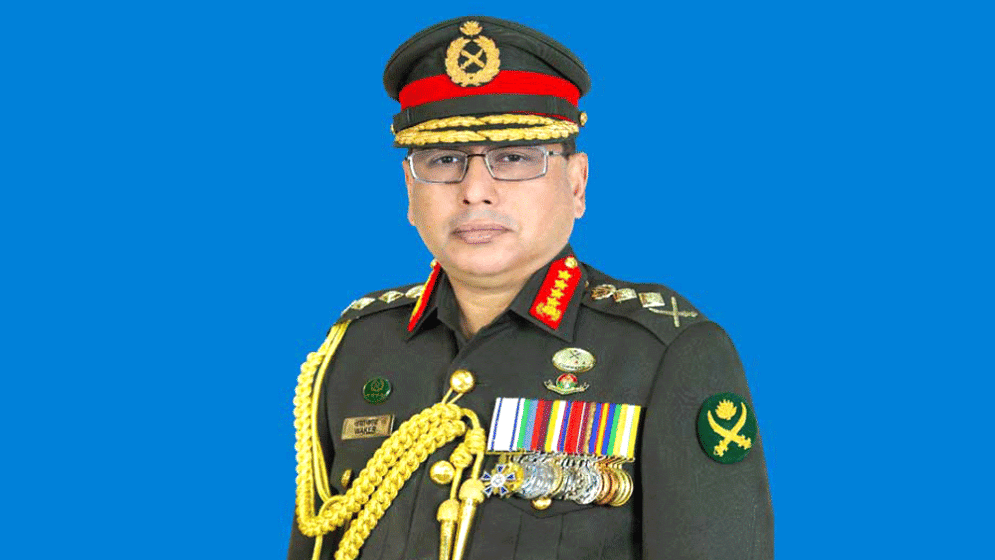
Army Chief General Waker-Uz-Zaman has laid out two core duties for the Bangladesh Army and all institutions involved in the upcoming election, underlining the military’s role in safeguarding a credible democratic process.
First, he affirmed that the Bangladesh Army will extend all necessary assistance to the civil administration and law-enforcement agencies to ensure that the election is conducted freely, fairly, and peacefully.
Second, he stressed the importance of restoring public trust in the electoral process. The Army Chief said the objective is to demonstrate clearly that the Government of Bangladesh, the Election Commission, law-enforcement agencies, and the armed forces are acting in unity and with firm resolve to deliver a transparent and credible election.
General Waker-Uz-Zaman made these remarks yesterday morning at the National Football Stadium in Gulistan during a coordination meeting with election-related stakeholders ahead of the 13th National Parliamentary Election and Referendum–2026. He also inspected the temporary army camp established at the venue.
During the meeting, officials said that military helicopters and naval vessels will remain on standby on polling day and in the post-election period to transport election officials and materials to remote or high-risk polling centers if required. Helicopters from all branches of the armed forces will be positioned across the country to allow rapid response in emergencies.
Following the meeting, Brigadier General Dewan Mohammad Manjur Hossain, Director of Military Operations at Army Headquarters, briefed the media at a press conference held at the Roller Skating Complex in Gulistan.
According to an ISPR press release, the Army Chief emphasized that all duties must be carried out with professionalism, neutrality, discipline, patience, and respect for citizens. He personally observed the activities of troops deployed in support of civil authorities and provided on-site guidance.
At the press conference, Brigadier General Manjur said that around 100,000 army personnel have been deployed nationwide to ensure a peaceful and fair election—nearly two and a half times the number used in previous polls. They are operating alongside large contingents from the police, RAB, BGB, Navy, and Air Force.
He said the armed forces are fully prepared to take firm, lawful action if necessary to protect voters and secure ballot boxes. The overall security situation is being monitored continuously from Army Headquarters in Dhaka.
Responding to questions, Brigadier General Manjur noted that comprehensive threat assessments have already been completed and deployments made accordingly. Regular patrols will continue so voters can reach polling centers without fear. To strengthen local security, camps have been set up at the upazila level and, in some cases, near individual polling centers.
The military is also prepared to respond to any post-election unrest. The Army Chief has reiterated that all operations will be conducted with strict neutrality. Ensuring that citizens can vote freely and safely remains a top priority, and any use of force, if unavoidable, will be strictly in line with the law.
Brigadier General Manjur added that a round-the-clock monitoring cell is operating at Army Headquarters to coordinate security operations. High-risk polling centers are being covered through security applications, police officers will use body-worn cameras, and drones and other modern technologies will be deployed for rapid response.
He pointed out that in past elections, only 40,000 to 42,000 personnel were used as striking forces, often stationed far from polling centers. This time, 100,000 army personnel are on duty, and for the first time, troops have been authorized to patrol up to polling-center premises.
To minimize inconvenience to voters, only essential personnel have been assigned to camps, while the majority of troops are directly engaged in election duties. Army units are conducting continuous day-and-night patrols to rebuild public confidence.
In addition to army personnel, Brigadier General Manjur said that 5,000 Navy members and 3,730 Air Force personnel are also deployed across the country.
The Army has established 544 temporary camps in 411 upazilas across 62 districts, as well as in major metropolitan areas. From these camps, joint patrols, checkpoints, and operations are being carried out regularly, alongside ongoing weapon-recovery efforts.
Over the past 14 days since January 20, nearly 150 weapons—mostly locally made and foreign pistols—have been recovered. Through joint operations, large quantities of arms and ammunition have been seized. To date, the Bangladesh Army has recovered 10,152 weapons and 291,000 rounds of ammunition, and has arrested 22,282 identified terrorists and criminals, handing them over to the police.
Brigadier General Manjur identified misinformation and disinformation as the most serious threat to the election, noting that the use of artificial intelligence has intensified the challenge. He warned that fabricated videos can now be created using only a person’s face.
He called on journalists to help counter such propaganda, emphasizing that timely, factual, and evidence-based reporting by mainstream media is critical to preventing the spread of false information.
Asked whether the unrecovered 1,331 weapons looted during the July uprising could pose a risk to the election, he said recovery operations are ongoing. Fifteen weapons were recovered in the last 24 hours alone, and between 2,000 and 2,500 patrols are being conducted daily. Joint operations remain active to ensure a peaceful election.
On the duration of the army’s deployment, he said the decision to deploy troops was taken by the government, and the length of their stay in the field will also be determined by the government.

