

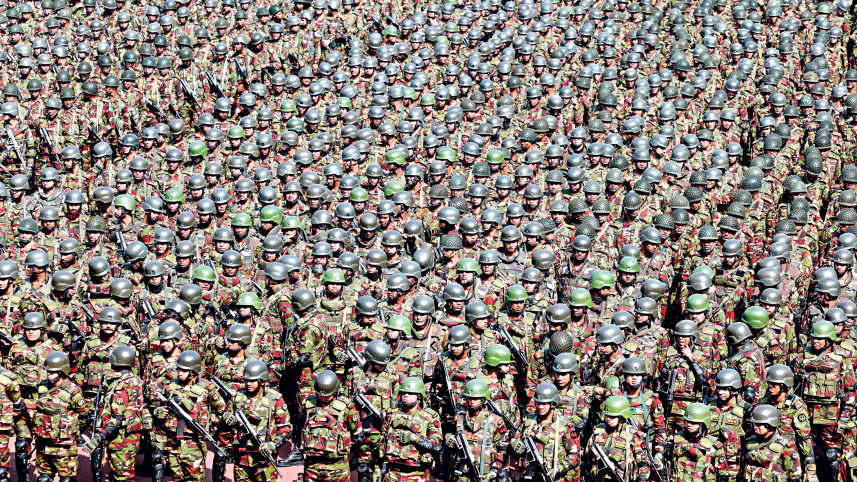
The Bangladesh Army has assured that it will take all necessary steps within the framework of the law to help ensure a free, fair and credible national election and referendum, a senior army official said yesterday.
Brigadier General Dewan Mohammad Monzur Hossain, director of the Military Operations Directorate at Army Headquarters, made the remarks during a press briefing at the Roller Skating Complex in Gulistan, outlining the army’s “In Aid of Civil Power” operations ahead of the February 12 polls.
He said troop deployment has been increased in phases to rebuild public confidence and allow voters to cast their ballots without fear. Army strength rose from 35,000 to 50,000 on January 10 and was further expanded to 100,000 troops by January 20.
Since then, army units have been conducting between 2,000 and 2,500 patrols every day from 544 temporary camps established across districts, upazilas and metropolitan areas. Troops are also carrying out joint operations with the police, Rapid Action Battalion (Rab) and Border Guard Bangladesh (BGB), in addition to manning checkpoints nationwide.
Monzur noted that the army has been supporting the civil administration in maintaining law and order for the past 18 months, during which it has occasionally performed policing duties. To that end, troops have been equipped with non-lethal weapons and crowd-control gear.
Over the past two weeks, security forces have recovered about 150 firearms—mostly locally made, along with some foreign pistols—as well as ammunition and materials used to manufacture cocktail bombs. Overall, the army has seized more than 10,000 firearms and nearly 291,000 rounds of ammunition so far, and detained over 22,000 identified criminals and militants, he said.
To support voting in remote and high-risk locations, military helicopters and watercraft will remain on standby to transport election officials and materials if necessary. At sensitive polling centres, police will use body-worn cameras, while law enforcement agencies will deploy drones and other surveillance tools to respond swiftly to any incident.
The army, Monzur added, is coordinating closely with district and upazila coordination cells and has set up a 24-hour monitoring centre at Army Headquarters.
He identified misinformation—particularly on social media—as one of the biggest challenges during the election period, warning that the threat has grown with advances in artificial intelligence.
Asked about the duration of the army’s deployment after the election, Monzur said the matter would be decided by the government.
He also warned against mob violence, stressing that the government, Election Commission, civil administration, law enforcement agencies and the armed forces are united in their commitment to holding a credible election. The army, he said, will act with complete neutrality and will only intervene when there is a threat to life or property, or when requested by the civil administration.
Addressing concerns raised by political parties and civil society groups, including a recent report by Transparency International Bangladesh, Monzur acknowledged that any violence or loss of life is undesirable. However, he said incidents have declined since the large-scale deployment of troops, despite logistical challenges in covering every remote and high-risk area.
Earlier in the day, Army Chief General Waker-Uz-Zaman visited the army camp at the National Stadium in Dhaka, where he reiterated the importance of neutrality, professionalism and strict adherence to the law during election duties.
According to the Inter-Services Public Relations (ISPR), the army chief also held coordination meetings with senior military officers, civil administration officials and law enforcement agencies to strengthen inter-agency cooperation and ensure peaceful, fair and orderly elections nationwide.

