

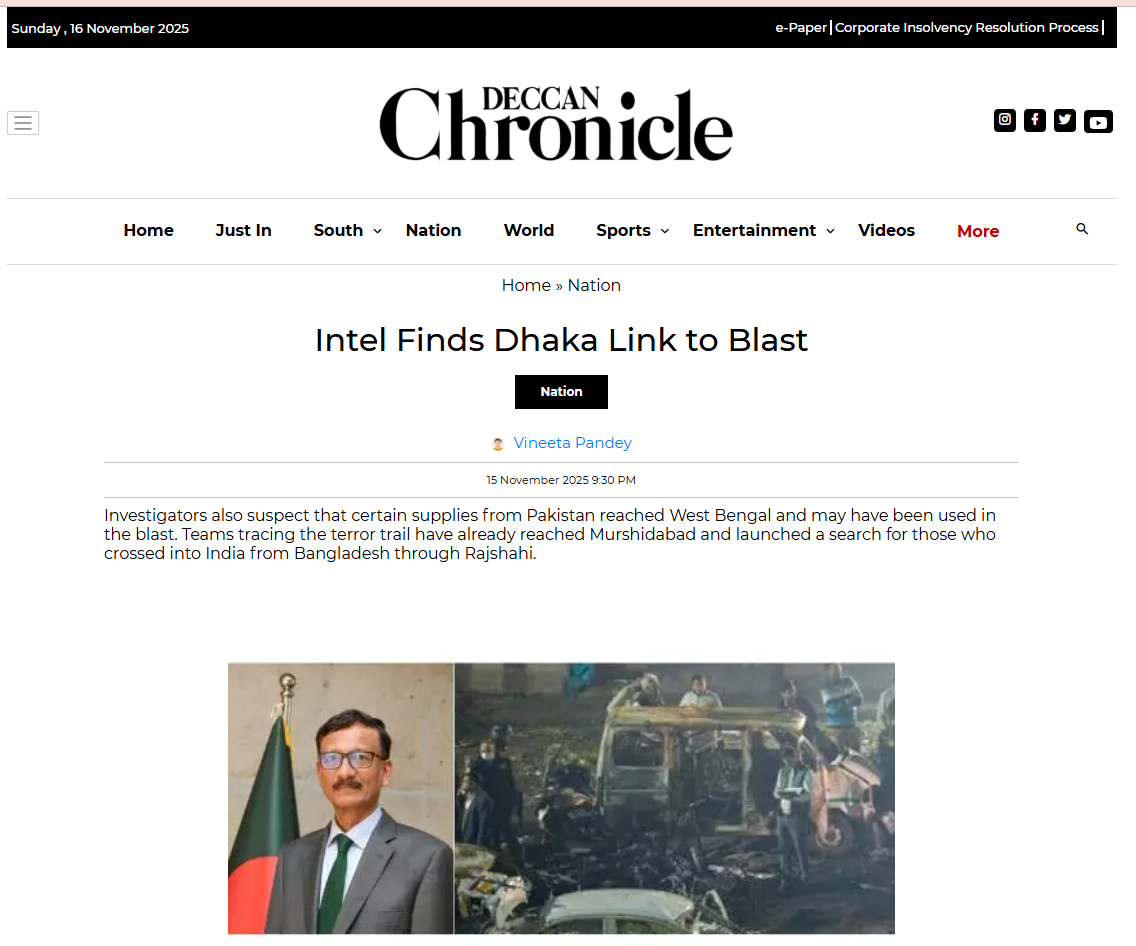
In the world of international politics, it’s common for countries to point fingers at their neighbours when something goes wrong. India has once again used this strategy, trying to blame Bangladesh for the tragic Red Fort blast in Delhi on November 10. A recent article in *Deccan Chronicle* (November 15, 2025) by Vineeta Pandey makes wild claims, trying to link Bangladesh and even Pakistan to the attack. The article suggests that high-ranking officials from Bangladesh were involved in secret meetings with the notorious terrorist group Lashkar-e-Taiba (LeT). However, the piece is filled with factual errors and baseless accusations, presenting a story more like a spy novel than real news.

Let’s break down these claims with facts. Pandey’s main accusation is based on an alleged meeting where Saifullah Saif, a LeT commander based in Pakistan, supposedly directed operations to officials from Bangladesh, including the country’s Ministry of Home Affairs and Dhaka’s mayor. Pandey also quotes Saif allegedly saying that Hafiz Saeed, the LeT founder, is planning something from Bangladesh. The article implies that Bangladesh’s interim government is somehow involved in supporting terrorism against India.
This is not just sloppy journalism- it’s misleading and malicious. First, the details don’t add up. No such meeting between these officials took place as described. Bangladesh’s Foreign Adviser, Md. Touhid Hossain, has strongly rejected these claims as “baseless,” stressing that Bangladesh does not allow its soil to be used for anti-India activities. Other sources, including diplomatic channels and intelligence reports, confirm that the meetings Pandey refers to were part of religious exchanges, not terror planning.
Let’s look at the facts: From October 24 to November 8, 2025, Iftikhar Elahi, a scholar linked to Pakistan’s Ahle Hadith group, visited Bangladesh for a religious event hosted by a local Ahle Hadith organization. These kinds of interfaith dialogues are common throughout South Asia. On November 15, the Khatme Nabuwat movement, which focuses on the finality of prophethood, held a peaceful conference in Dhaka. This event, which drew thousands of peaceful attendees, was about religious beliefs, not terrorism. Bangladesh’s government ensured strong security for the event, and it concluded without any issues. For Pandey to link this peaceful religious gathering with LeT activity is not just ignorant- it’s dangerous.
Pandey’s article conveniently ignores these peaceful contexts and distorts the facts, quoting vague and unrelated claims about Hafiz Saeed. The line about Saeed “planning something from Bangladesh” is actually taken from a generic LeT propaganda video from months earlier, which has nothing to do with Dhaka. This is an example of sensationalism, connecting random dots to create a narrative that fits an agenda, no matter how far from the truth it is.
But why is this narrative being pushed now, right after the blast and at a time when Bangladesh’s domestic issues are about to make headlines? This seems less about uncovering new intelligence and more about distracting from India’s own failures. India has a history of quickly blaming Pakistan for attacks like the one in Pahalgam earlier this year, but investigations often don’t lead to conclusive evidence. Similarly, the recent Delhi blast investigation is pointing toward domestic sources and radicalization, yet the narrative continues to focus on Bangladesh.
Bangladesh’s growing ties with Pakistan since August 2024, particularly in defense and trade, have caused concern in India. This narrative appears to be part of an effort to damage these relationships and undermine Bangladesh’s stability, particularly as Bangladesh prepares for important milestones, including the International Crimes Tribunal’s verdicts. By painting Bangladesh as a terrorist hub, India might be trying to preemptively weaken the country’s position on the global stage.
The timing is no accident. India may also be trying to tarnish Bangladesh’s image ahead of these significant decisions, especially with the growing international attention on minority issues in India. By stirring up false narratives, India could be aiming to create instability that distracts from its own internal challenges and prevents progress on key diplomatic initiatives.
What’s more troubling is that the claims about a Bangladesh-Pakistan supply route for the explosives used in the blast are unfounded. The materials used for the attack- likely ammonium nitrate- appear to have been sourced within India or through other birder, not Bangladesh. Pandey’s attempt to tie the blast to cross-border smuggling is misleading. Bangladesh’s strict border control and cooperation with India have reduced infiltration by over 40% in the past year.
Bangladesh is a country committed to peace, pluralism, and counter-terrorism. Our interim government is actively working with international partners like Interpol and the UN on de-radicalization efforts. This narrative is not an attempt to defend ourselves, but to stand firm in the face of false accusations. Bangladesh has consistently played a role in regional stability, whether by hosting Rohingya refugees or mediating regional disputes.
To Vineeta Pandey and her editors: journalism should be about facts, not sensational claims. Quoting anonymous sources without evidence only deepens distrust and perpetuates harmful narratives. To India: rather than wasting energy on accusing neighbors, let’s focus on real security challenges- cybercrime, climate change, or tackling any extremist groups together.
The international community should see through these baseless allegations. Bangladesh calls for a transparent and independent investigation into the Delhi blast, so that justice can be served and South Asia can heal its divisions.

