

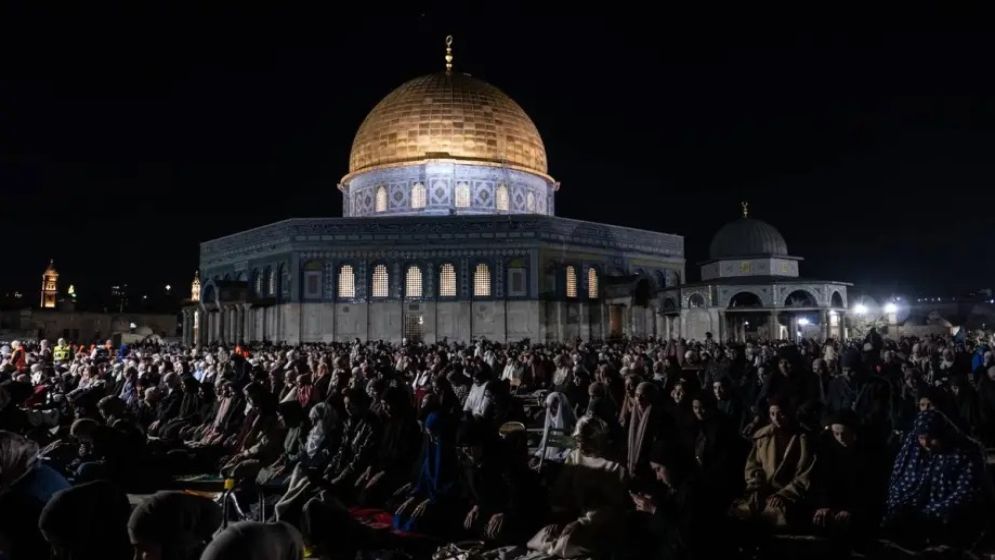
Israeli authorities are reportedly planning to impose restrictions on Muslims visiting Al-Aqsa Mosque for prayers during the upcoming holy month of Ramadan, according to Sheikh Ekrima Sabri, a prominent Islamic scholar and former Grand Mufti of Jerusalem, in an interview with Anadolu Agency.
Sheikh Sabri, who also heads the Supreme Islamic Council in Jerusalem, expressed deep concern over the move, calling it a serious impediment to Muslim worship at the third-holiest mosque during Ramadan, which begins midweek.
He noted that Israel’s intentions became evident after the appointment of Maj. Gen. Avshalom Peled as the new police commander in occupied East Jerusalem in early January. This step is widely seen as supporting the controversial plans of far-right National Security Minister Itamar Ben-Gvir regarding Al-Aqsa. The Israeli newspaper Haaretz remarked, “It appears Ben-Gvir is doing everything to escalate tensions.”
“Muslims traditionally greet Ramadan with hope and devotion, following the example of Prophet Muhammad at the end of Shaaban,” Sheikh Sabri said. “But in Jerusalem, the occupying authorities’ harsh measures make it difficult for worshippers to access Al-Aqsa Mosque.”
He added that dozens of young men have already been prevented from entering the mosque, and restrictions will remain in place during Ramadan for worshippers arriving from the occupied West Bank. “This will reduce the number of attendees compared to previous years, limiting religious freedom and impacting Muslims observing the fasting month,” he said.
Typically, hundreds of thousands of Palestinians travel from the West Bank to East Jerusalem during Ramadan to pray at Al-Aqsa. However, since the outbreak of war on October 7, 2023, Israel has tightened control at military checkpoints, making access increasingly difficult. Over the past two years, only a small number of permits issued by the Israeli army have been granted, which Palestinians say are extremely hard to obtain. This year, no special arrangements for Ramadan have been announced.
Recently, Israeli authorities issued temporary orders banning hundreds of Palestinian residents of East Jerusalem—mostly young men—from entering the mosque during Ramadan. Some of these orders are valid for up to six months.
The restrictions come amid criticism from Palestinian officials of Israel’s right-wing government, led by Prime Minister Benjamin Netanyahu, who they accuse of altering the long-standing “status quo” at Al-Aqsa. Despite repeated objections from the Islamic Waqf Department, local police have allowed Israeli extremists to enter the mosque compound since 2003.
“There is no doubt the government aims to carry out its aggressive agenda at Al-Aqsa,” Sheikh Sabri said. “For years, they have demanded open public entries, unrestricted prayers, the use of ritual horns, and prostrations. What was once hidden is now being done openly.”
He also warned that Israel is attempting to assert sovereignty over the site while undermining the authority of the Islamic Waqf.
These measures are not limited to Al-Aqsa; they also target Palestinian neighborhoods across occupied East Jerusalem, particularly near the mosque. Sheikh Sabri described demolition policies as “racist, unjust, illegal, and inhumane,” comparing them to Britain’s colonial-era policies in Palestine.
He called on Arab and Muslim nations to support Palestinians in Jerusalem and urged leaders to take responsibility for protecting the city and the sanctity of Al-Aqsa Mosque.

