

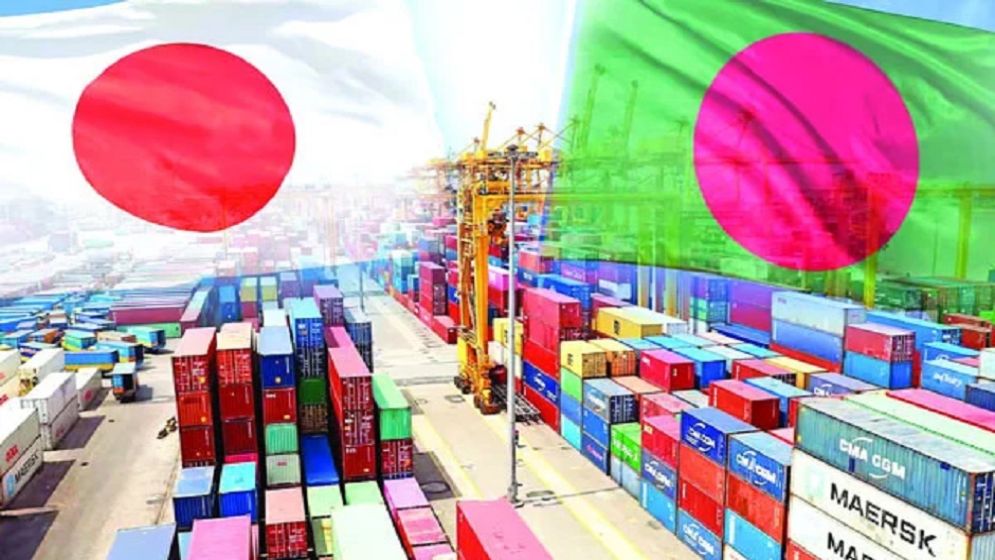
Bangladesh has signed an Economic Partnership Agreement (EPA) with Japan last Friday in Tokyo by Bangladesh’s Commerce Adviser Sheikh Bashiruddin and Japan’s State Minister for Foreign Affairs HORII Iwao.
Spanning 1,272 pages and comprising 22 chapters, the EPA covers a wide range of areas, including trade in goods and services, investment, intellectual property, labour, the environment, and dispute settlement.
The government says the EPA is not merely a trade deal but a structural foundation for strengthening the “strategic partnership” between Bangladesh and Japan. However, a section of economists and business leaders believe the agreement presents challenges as significant as the opportunities it creates—particularly in terms of competition, policy reform, and capacity building.
One of the most notable features of the agreement is that around 7,379 Bangladeshi products will enjoy 100 per cent duty-free access to the Japanese market. In return, 1,039 Japanese products will receive duty-free or preferential access to the Bangladeshi market.
According to stakeholders, the tariff exemptions will reduce the prices of Bangladeshi exportable goods and enhance competitiveness in a high-value market such as Japan. Sectors expected to benefit most include readymade garments, leather, agricultural and processed food products, light engineering, and IT-related goods. However, these benefits will not materialise overnight. Under the agreement, tariffs on some products will be eliminated from the date the EPA comes into force, while others will be phased out over periods of four, six, eight, eleven or even sixteen years. As a result, real gains will take time and require sustained preparation.
Another key aspect of the EPA relates to rules of origin and trade facilitation. Under the agreement, both countries will issue certificates of origin for goods and exchange and verify information when necessary. Separate origin rules have been set for specific products. Experts warn that unless these rules are implemented effectively, duty-free benefits may remain largely theoretical. Without stronger administrative capacity in customs, certification, verification, and digital management systems, exporters could face higher costs and delays rather than smoother trade.
A substantial portion of the agreement deals with services and investment. It states that investors from both countries will receive equal treatment and legal protection, with disputes to be resolved through consultation, and if necessary, mediation or arbitration. In practice, however, Bangladesh has not offered major new concessions to Japanese investors. Opportunities for wholly foreign-owned businesses or branch offices remain limited, signalling that while Bangladesh is keeping its doors open, it also intends to retain regulatory control.
Maria Howlader, Secretary General of the Japan Bangladesh Chamber of Commerce and Industry (JBCCI), said the agreement provides duty-free market access to Japan and creates the potential for increased Japanese investment. “But turning this opportunity into reality will be the biggest challenge,” she noted.
The EPA also recognises e-commerce, online transactions, digital signatures, and electronic contracts, a move expected to make digital trade more secure and efficient. At the same time, it calls for government procurement processes to be more transparent and competitive. This opens up opportunities for qualified Bangladeshi IT, engineering, and service firms to participate in Japanese public procurement. However, experts caution that without meeting international standards, transparency requirements, and robust documentation practices, competing in such tenders will be difficult.
The agreement places strong emphasis on labour rights, fair wages, safe working conditions, and environmental protection. It also includes obligations to protect intellectual property, although Bangladesh has been granted transition periods of five to ten years in certain areas. Analysts believe that once these transition periods expire, substantial investment and policy reforms will be required to strengthen intellectual property laws and institutions, potentially creating tensions in maintaining policy balance across some industries.
Under the EPA, Bangladesh will also gradually reduce tariffs on Japanese products. This could lead to a decline in import duty revenues, increasing pressure on the fiscal balance. At the same time, cheaper Japanese machinery and high-quality consumer goods may intensify competition for domestic industries, particularly emerging sectors.
Concerns have also been raised that complying with strict sanitary and phytosanitary standards in agriculture, food, and fisheries could raise production costs. According to data from Bangladesh Bank and the Export Promotion Bureau, Bangladesh currently runs a trade deficit with Japan. In the 2024–25 fiscal year, Bangladesh’s exports to Japan stood at USD 1.41 billion, while imports amounted to USD 1.87 billion.
JETRO Country Representative Kazuiki Kataoka said duty-free access would help Bangladesh compete on price, but stressed that producing high-quality products that meet Japanese consumer expectations remains crucial.
The EPA with Japan represents a strategic opportunity for Bangladesh, particularly in the post-LDC graduation period. However, it offers no automatic gains. Without a comprehensive approach encompassing quality improvement, skills development, administrative capacity building, and policy reform alongside tariff benefits, there is a real risk that the opportunity could be missed.

