

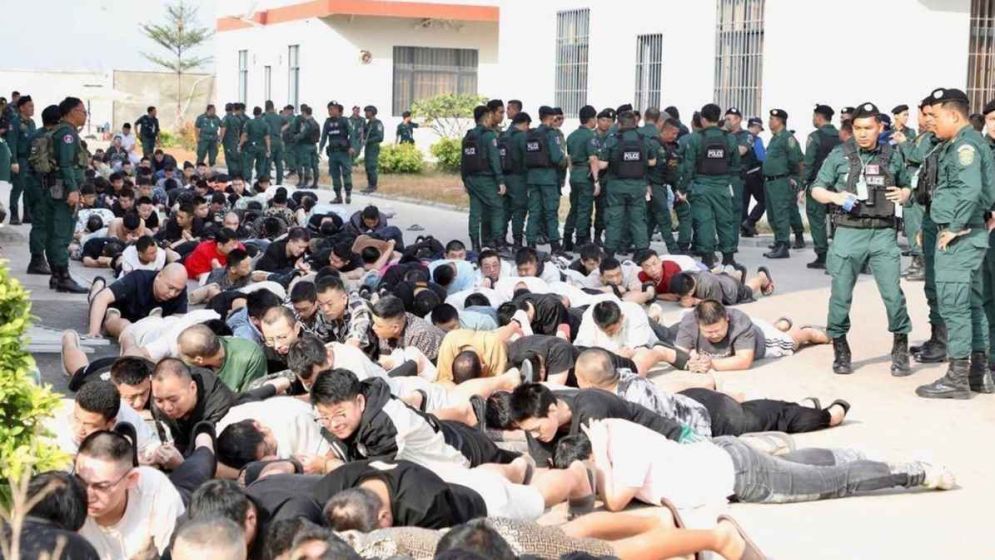
Nearly 180 Myanmar citizens are among more than 2,000 foreign nationals detained by Cambodian authorities in a raid on an online fraud compound in Bavet, a border city in Svay Rieng province, on 31 January, according to workers held at the facility.
Of the foreigners detained, 1,792 were from mainland China, five from Taiwan, 177 from Vietnam, and 179 from Myanmar, according to Cambodia’s Interior Ministry.
The compound, notorious among trafficked workers, is one of Cambodia’s largest scam hubs, where thousands are confined, forced to work and routinely abused. A Myanmar worker who had been trapped inside told The Irrawaddy that Bavet compounds are the “worst” in the country, with many victims sold multiple times before ending up there.
He said workers were locked inside buildings, forced to work up to 20 hours a day, denied wages, and subjected to beatings. Each building was guarded by security personnel and surrounded by electric fencing, making escape impossible, he said.
A Myanmar woman trafficked to Bavet said fellow victims had repeatedly sought help from the Myanmar Embassy and migrant‑support groups but received no assistance. When Cambodian authorities finally stormed the compound, workers surrendered rather than attempting to flee, she said.
“They raided around 8 am. Large numbers of personnel surrounded the buildings before entering room by room. Nobody on our floor tried to run. We let them arrest us,” she said.
The 27‑year‑old trafficking and forced labor victim said she ran a small restaurant in Myawaddy town near the Thai border before moving to Mandalay after the junta’s October crackdown on scam compounds. She was then lured by a broker who promised her a post as a Chinese interpreter on a monthly salary of 4 million kyats (over US$ 900)—and was trafficked to Cambodia via Thailand on 21 December.
“When I arrived in Cambodia, I lost contact with the agent, whose phone was turned off. Then a woman called me and said that a Chinese boss would come and get me. I ended up in the scam compound,” she said.
Despite having no computer skills, she was trained to target Japanese nationals online. Those who refused to work were ordered to pay $10,000 in “compensation.”
“I have had no days off after arriving. I had to work all day and barely had time to sleep. The living conditions were poor,” she said.
After being detained in the raid, she and others were able to contact the Myanmar Embassy, which told them their names were already on file and that repatriation would take between two weeks and one month. Nearly 1,000 Myanmar nationals are currently waiting to be repatriated, she said.
The Irrawaddy attempted to contact the Myanmar Embassy in Phnom Penh but received no response.
The woman said many detainees remained anxious about returning home, citing an acquittance from Mandalay who was repatriated on 25 January but reportedly held for questioning by junta officials in Yangon.
Last year’s junta crackdown, staged amid mounting international pressure, reportedly pushed many Myawaddy scam operations into Cambodia, triggering a fresh wave of human trafficking.
Five Myanmar workers interviewed by The Irrawaddy said they arrived in Cambodia last year. A 25‑year‑old man from Mandalay returned home in October after paying a $6,500 “release fee” to the scam syndicate. A 21‑year‑old man from Yangon’s Dala Township said he fled after his scam compound came under fire during December’s Thai‑Cambodian border clashes, and made his own way back to Myanmar.
The three other workers—all of them women—remain in Cambodia. Two escaped scam compounds during raids in early January and are now seeking other work.
“We haven’t contacted the Myanmar Embassy because we will be forced to return if we do,” said a 20-year-old woman from Sagaing’s Wetlet Township, adding that her group pawned their homes to pay for flights and agents’ fees after losing their livelihoods in Myanmar.
“We now plan to move to Thailand for work, but we are still stranded in Poipet [on the border with Thailand] because we don’t have money for transport.”
A source close to the Myanmar Embassy in Phnom Penh said thousands of Myanmar nationals have contacted the mission seeking help with food, shelter and repatriation following recent raids on scam compounds.
Cambodian authorities are transferring Myanmar detainees to the embassy for processing. According to the Cambodian Immigration Department, 729 Myanmar nationals were handed over in three batches—136 on 23 January, 430 on 25 January, and 163 on 26 January.
Some of those who registered with the embassy for repatriation did not show up, said the source.
Five years of junta rule has left Myanmar’s economy in ruins, with job losses and military conscription driving an exodus of workers across the border. With few options and rising desperation, many are lured by brokers promising easy money abroad.

