

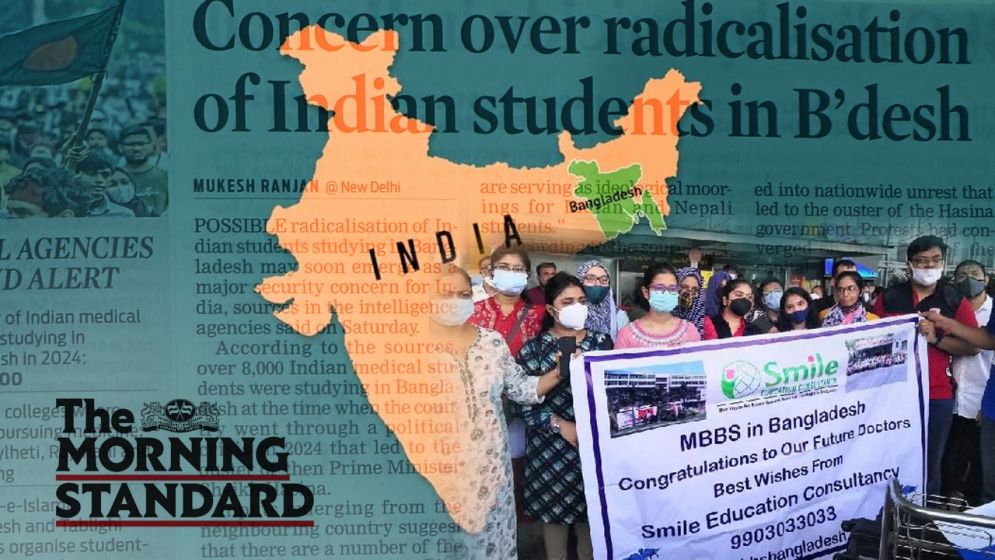
The government and academic sources in Dhaka have dismissed a recent report published by the Indian daily The Morning Standard that claimed Indian students studying in Bangladesh are being exposed to “radicalisation networks.”
Officials and education experts termed the report as “baseless, speculative and damaging to the image of Bangladesh’s education environment.”
The Indian newspaper, in a story dated 26 November, alleged that over 8,000 Indian medical students enrolled in Bangladeshi colleges were vulnerable to extremist influence from Jamaat-e-Islami Bangladesh, its student wing Islami Chhatra Shibir, and handlers linked to Pakistan’s ISI. It further claimed that religious congregations and encrypted online platforms were being used to “indoctrinate” Indian students.
Authorities reject the claim
Senior government officials in Dhaka said no such incident or investigation has ever been reported involving Indian students in extremist activities.
“There is not a single name, arrest, or case that supports these allegations. Such reporting without evidence only spreads fear and undermines decades of educational cooperation between our two countries,” a senior official from the Ministry of Education told this newspaper.
The official added that more than 9,000 Indian students are currently enrolled in various medical and technical universities in Bangladesh, enjoying a “safe and academically active environment.”
Campus politics, not extremism
Education analysts note that some student groups previously barred from campus activities were recently allowed to participate in student union elections following political transitions in 2024.
“This is part of a democratic process, not a sign of radicalisation,” said a Dhaka University faculty member. “Bangladesh’s security agencies remain alert, and universities operate under clear anti-extremism policies.”
Religious gatherings are peaceful
The Morning Standard report also referred to large-scale Islamic gatherings such as the Bishwa Ijtema, suggesting they serve as informal recruitment grounds.
Officials dismissed the suggestion, pointing out that the Ijtema is the second-largest peaceful Muslim congregation in the world, attended annually by millions from across Asia, including India and Nepal.
“No one has ever been arrested from these events for extremist activities. These are spiritual gatherings, not recruitment drives,” a senior police source said.
Zero tolerance against extremism
Bangladesh continues to maintain a zero-tolerance policy toward extremism.
In 2025 alone, law enforcement agencies arrested more than 200 individuals linked to radical online networks.
Security coordination between India and Bangladesh remains active and strong, officials confirmed.
Political motives suspected
Observers in Dhaka and Delhi believe the publication of such reports coincides with growing diplomatic tension between the two neighbours following Bangladesh’s renewed request for the extradition of former Prime Minister Sheikh Hasina, who remains in India after a tribunal in Dhaka sentenced her to death earlier this year.
“It appears that certain Indian outlets are attempting to project Bangladesh as politically unstable or unsafe,” said a South Asia security analyst. “Such narratives ignore the reality on the ground, where campuses are calm and international students feel secure.”
Students feel safe
Indian students interviewed by this newspaper confirmed that they feel safe, respected, and comfortable in Bangladesh.
“We’ve never faced any pressure or radical activity. We are busy with our studies,” said Arjun Patel, an MBBS student in Dhaka. “Our parents in India have nothing to worry about.”
The bottom line
There is no credible evidence that Indian students in Bangladesh are being radicalised or targeted by extremist groups.
The Morning Standard story, lacking names, documentation or official confirmation, appears to rely solely on anonymous sources.
Bangladesh remains a safe, moderate, and welcoming destination for higher education. Both Dhaka and New Delhi continue to cooperate closely on counter-terrorism and education — and officials stress that isolated, sensational headlines should not distort that long-standing friendship.

