

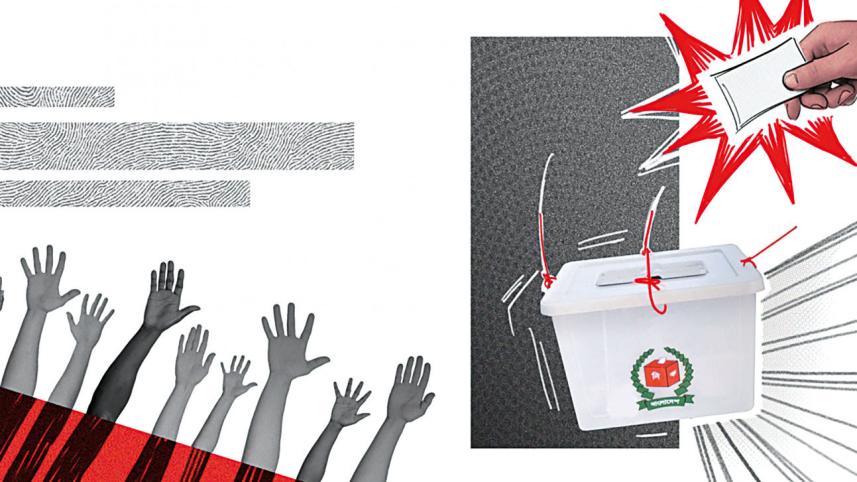
The interest is reflected in the number of international observers dispatched: about 500 foreign observers from 16 countries and organisations are coming, with the EU alone sending about 200 observers, its full-fledged delegation since 2008.
Foreign policy analysts say this election has garnered closer global attention because any changes here have implications not only in the region but also beyond.
“The international community has collective support for the election– they want Bangladesh to be a stable and moderate Muslim country,” said M Humayun Kabir, a former ambassador and president of Bangladesh Enterprise Institute.
Closer to home, India is closely monitoring the situation, as bilateral ties have hit rock bottom following the ouster of the Awami League government and its sheltering of deposed prime minister Sheikh Hasina and her party members.
Both countries have imposed restrictions on each other’s exports, while India has drastically restricted visas for Bangladeshis.
India has security concerns for the Northeast region, while Pakistan’s improving ties with Bangladesh under the interim government are another worry for New Delhi, said Shahab Enam Khan, a professor of international relations at Jahangirnagar University.
“Therefore, it is likely to engage with Bangladesh, sacrificing its ego after the polls,” he said.
India is likely to be concerned from political and security standpoints if Jamaat-e-Islami wins the election but would be comfortable with a BNP-led government, said Michael Kugelman, senior fellow for South Asia at the Washington-based think tank Atlantic Council.
The BNP has already expressed its interests about wanting to engage with India, he said.
However, Khan says Indian diplomats in Dhaka also met with Jamaat leaders, suggesting New Delhi is also ready to work with Jamaat if elected.
Meanwhile, Pakistan has boosted its relations with Bangladesh.
In February 2025, the two nations resumed direct trade for the first time since 1971, and recently resumed direct flights after 14 years. The two countries also held military and defence dialogues.
A change in Indian policy on Bangladesh is likely to affect Pakistan’s influence in Bangladesh after the election, Khan said.
“Pakistan will be comfortable working with either of the parties — BNP or Jamaat,” he added.
Beyond the subcontinent, China, Bangladesh’s largest trading partner, has maintained the strong relations it harvested with the Hasina regime with the interim government.
The interim government managed Chinese commitment of $2.1 billion in investments, loans and grants.
Throughout last year, China engaged with all the political parties and arranged visits to China.
“China has always wanted stability and wants the same now for protecting its trade and investments. They know they cannot go for long-term planning and implementation unless there is an elected government,” said Kabir, the former ambassador.
The Western world too wants the election to bring stability to the country.
The US is unlikely to take a strong stand on the need for a free, fair, and credible election, even though it may state this publicly, according to Kugelman.
Its primary concern is overall stability and that the election will be peaceful, and that any election-related violence will be minimised.
“In particular, it seeks to ensure that such violence does not imperil US interests or assets in Bangladesh,” he told The Daily Star.
The Trump administration will be perfectly comfortable with whoever leads the next government, so long as that government is willing to engage with Washington, do business, and — most importantly from Washington’s perspective — discuss lowering tariffs and purchasing more American goods, Kugelman said.
On the perception that the US favours Jamaat for some reason, Kugelman said the American government does not favour any particular political party.
On US Ambassador Brent Christensen’s remarks on reducing Chinese influence, Kugelman said the US wants Bangladesh to rely less on Chinese capital and infrastructure development.
“This may suggest a willingness to bring US investment, including potentially from DFC, into Bangladesh,” he said.
China is a major source of funds for Bangladesh’s infrastructure.
If other countries like the US come up with funding, Dhaka will definitely welcome that, Kabir said.
“Bangladesh’s imports from the US are already increasing and the defence cooperation can also grow where feasible,” he added.
The EU, the largest buyer of Bangladesh’s products with annual imports worth $22 billion, along with the UK, Canada and Australia, have always promoted democracy, human rights, labour rights, gender equality and minority rights in Bangladesh.
“We want a free, fair and credible election and stability in Bangladesh. It has direct implications for Europe,” a European diplomat told this correspondent.
He said they need a stable supply chain and prevention of irregular migration, and it will not be possible without stability here.

