

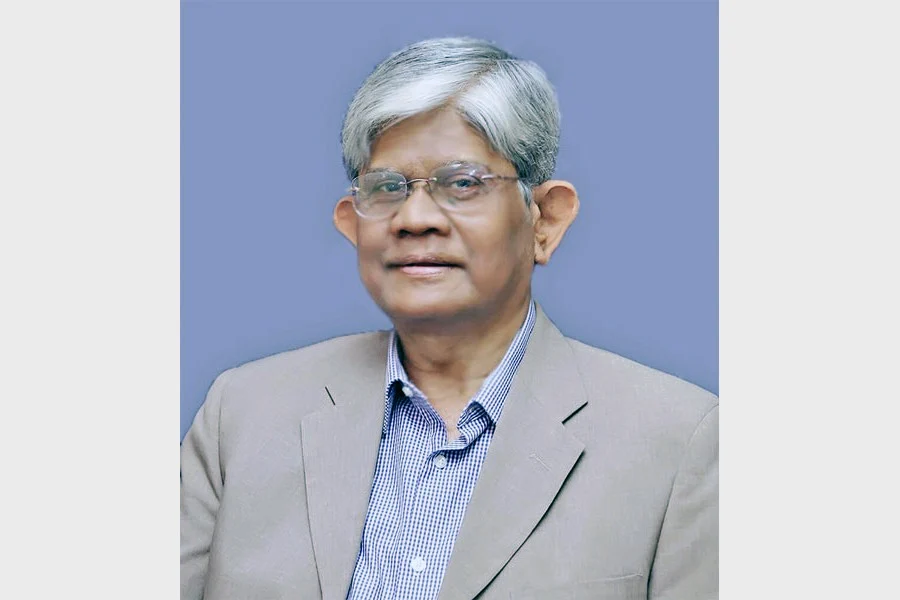
Finance Adviser Dr Salehuddin Ahmed on Tuesday expressed confidence that the interim government will leave behind a stable and “satisfactory” economic situation for the next elected government, saying the economy has moved out of a fragile phase.
“The economy is now on stable ground. It is no longer shaky like before, and the next government should not face serious obstacles in continuing from here,” he told reporters.
Dr Salehuddin was speaking after chairing the fifth meeting of the Advisers Council Committee on Government Purchase at the Cabinet Division conference room in the Bangladesh Secretariat. However, he cautioned that several structural challenges still remain.
He said the interim government has focused on stabilising economic fundamentals, creating a platform from which future administrations can proceed without disruption.
Responding to questions about rising public debt, the Finance Adviser acknowledged that government borrowing had increased but stressed that significant repayments had also been made.
“We have repaid nearly six billion dollars in external debt. Borrowing alone does not tell the full story—debt repayment is equally important,” he said.
He added that the government intentionally avoided large-scale, loan-funded mega projects to prevent further debt pressure.
“We stayed away from expensive infrastructure projects such as tunnels or massive loan-based schemes. That decision helped keep public debt from worsening,” he explained.
Dr Salehuddin identified employment generation as one of the most difficult challenges faced by the interim government, noting that job creation depends largely on small and medium enterprises.
“SMEs are crucial for employment, but fiscal limitations restricted our ability to provide adequate support. Large factories do not generate enough jobs and involve complex challenges,” he said.
Clarifying earlier comments about economic risks, he said the current stability must be preserved through continued reforms.
“What we’ve done is not a final solution. These reforms need to be strengthened and carried forward carefully. That is the real challenge,” he said, adding that access to low-cost foreign assistance has declined.
He emphasised that meaningful reform requires time, cooperation and administrative discipline.
“Reform is not about announcements. It requires process and patience. Our system is complicated, and without cooperation, progress becomes extremely difficult,” he said.
Highlighting governance improvements, the Finance Adviser said digitisation of land records and khatian maps has significantly reduced costs and improved transparency.
“Services that once cost Tk 500 are now available for Tk 20. This is one of the most impactful reforms in public service delivery,” he said, noting that digital land services are being expanded nationwide.
Dr Salehuddin also confirmed that the government is preparing to face international arbitration related to financial and money laundering allegations involving business entities linked to the S Alam Group.
He said arbitration proceedings have been initiated at the International Centre for Settlement of Investment Disputes (ICSID), a World Bank-affiliated body.
“We have received formal notice and must respond. This involves a substantial amount of money and is a very serious issue,” he said.
The government has decided to appoint international legal counsel to contest the case, and a delegation is expected to travel to Washington, DC, as part of the process.
On power sector reforms, he said electricity tariffs are being restructured to improve efficiency rather than raised indiscriminately.
“This is not a price hike. It is a rational adjustment within the system and will not affect power supply,” he said, adding that operational inefficiencies at power plants, including Ashuganj, are being reviewed.
Despite criticism, Dr Salehuddin maintained that the interim government has carried out significant structural reforms, even if they are not immediately visible.
“People often judge by visible projects. But many deep, procedural reforms have taken place. Those who don’t want to see them, won’t,” he said.

